
Non-invasive water leak detection · Glenwood 2768
Water Leak Detection Glenwood
Non-Invasive · Same-Day
ProLeak supports Glenwood property owners with hidden water leak detection using acoustic listening, thermal imaging, tracer gas, and pressure testing, locating the exact leak point before excavation. Free inspection, licensed technicians, 4.9 stars from 1,000+ clients.
Non-invasive leak location - find before you dig
Free inspection appointment
Licensed water leak specialists
Rated 4.9 stars · 1,000+ clients
Free inspection - Glenwood 2768 & surrounds
Book a free Glenwood inspection
Transparent pricing · Licensed technicians · Same-week available
Responds within business hours · Same-week bookings available
4.9 from 1,000+ clients
Verified reviews
Licensed technicians
NSW building licence
AS 3740 & AS 4654
Australian Standards compliant
Free inspection
Transparent pricing
24/7 support
Book any time
Concerned about a hidden water leak in your Glenwood property?
5 warning signs of a hidden water leak in Glenwood
Noticeable rise in water bill
A sudden water bill increase from Sydney Water, with usage remaining steady, is a reliable clue that a hidden pipe leak may be present. A 2mm leak under pressure can waste 100,000+ litres a month.
Wet soil or grass that looks unusually healthy
Unusually wet soil or extra green grass without recent rain often means water is being supplied from below, which may indicate an underground pipe leak.
Sound of water movement when taps are off
Water running sounds in walls, under floors, or at meters when taps are not in use often mean water is escaping from the pressurised system somewhere on the property.
Water pressure has dropped with no obvious reason
If water pressure decreases across the home and not just at one outlet, it can indicate a leak in the main supply line.
Cracking internal walls or raised floors
Gradual cracks in interior walls, lifting or raised floor tiles, and doors or windows that begin jamming without any building changes may be warning signs of clay soil movement from an underground pipe leak beneath the slab.
Accurate water leak detection in Glenwood 2768
Why Glenwood properties face higher concealed pipe failure risk than coastal Sydney
As one of Sydney’s most established western suburbs, Glenwood 2768 has a varied residential profile, from 1970s and 1980s brick veneer homes through to recently built townhouse and unit developments near the Westpoint town centre precinct. ProLeak’s hidden water leak detection across Glenwood reflects that range: in older homes, leaks are most often found at original under-slab copper pipe connections weakened by 40–50 years of Glenwood clay soil movement, particularly at joins and elbows; in newer properties, failures more commonly occur at soldered or push-fit connections in walls, or around the meter connection and main supply lateral from the street.
Why Glenwood clay soil movement causes more pipe failures than coastal Sydney
In Glenwood, the expansive clay beneath properties and underground water supply pipes moves as conditions change from wet to dry. Saturated clay expands after rain, then contracts in dry periods, placing ongoing physical stress on pipe joins and connections every season. After 40–50 years of this repeated cycle, original copper pipe joins beneath Glenwood slabs can crack, separate, or corrode at pressure points. This is why underground pipe failures in Glenwood are significantly more common than in eastern Sydney suburbs, where sandstone bedrock provides a stable foundation. Western Sydney’s extreme temperature range worsens the issue, because above-ground copper pipes experience greater thermal expansion and contraction than those in coastal suburbs, accelerating joint fatigue.
Use the Sydney Water meter test to check for a hidden leak before calling
Turn off every water-using item in your Glenwood property, including taps, appliances, and garden watering systems. Find your water meter, usually located near the front boundary, and check the reading. Wait 15–20 minutes without using any water, then check again. If the meter numbers have moved, or the small flow indicator dial is turning, water is flowing somewhere even though everything is off. This confirms a leak is present, and ProLeak’s free inspection will locate it. If your Sydney Water bill has spiked without this test confirming flow, the leak may occur intermittently or only under pressure and should still be inspected.
Pool leak detection in Glenwood - supporting pool owners across Western Sydney
Western Sydney suburbs, including Glenwood, typically have much higher rates of residential swimming pool ownership than Sydney’s inner and eastern suburbs. ProLeak’s call-outs in Glenwood regularly include pool leak detection, particularly for pools in service for 10+ years where sealant at skimmer boxes, return fittings, and hydrostatic pressure relief valves has deteriorated, or where clay soil movement beneath the pool structure has placed stress on shell waterproofing at the base-to-wall junction. In a Glenwood property, an undetected pool leak can waste 50,000–100,000 litres per month, often appearing as a significant Sydney Water bill spike that is wrongly attributed to evaporation.
What ProLeak's detection typically finds in Glenwood properties
In 1970s–80s Glenwood properties, acoustic and tracer gas detection most commonly points to failures in under-slab hot water copper pipe joins, as the hot water reticulation system experiences constant expansion and contraction and tends to fail first. In newer homes across Glenwood, pressure testing more commonly identifies faults at the main cold water supply connection at the meter, or at push-fit wall cavity connections lacking maintained access. ProLeak accurately locates the issue before drilling, cutting, or excavation begins.
Glenwood falls within the Blacktown Council area. All detection work and any repairs carried out in Glenwood are completed by licensed technicians in line with NSW plumbing standards. You can verify our licence through NSW Fair Trading. Sydney Water’s pipes and connections page clarifies the division of responsibility for pipes and connections.
Detection summary
Glenwood 2768 · Water leak detection overview
Property construction period
Housing ranges from 1970s–90s brick veneer homes to newer townhouses. Older homes face under-slab pipe failure risk, while newer properties are more likely to fail at connections and fittings.
Property ground conditions
Seasonal clay movement puts pressure on underground pipe joints, creating a higher rate of pipe failure than in coastal suburbs.
Pool ownership in local properties
High Western Sydney pool ownership makes leak detection a key service across Glenwood Council
Key techniques for leak detection
Acoustic listening for concealed under-slab leaks; tracer gas for underground mains; thermal imaging for leaks hidden in walls; pressure testing to confirm supply line problems
Where hidden water leaks occur in Glenwood properties
Common hidden leak points across Glenwood homes
Pipe leak listening devices
Key method · Under-slab and underground
Acoustic amplifiers are positioned on pipes, slabs, and ground surfaces to detect the unique sound signature created when pressurised water escapes from a pipe breach. This produces a characteristic frequency that sensors can read through concrete, soil, and building materials. Sensor frequency selection depends on pipe material and depth.
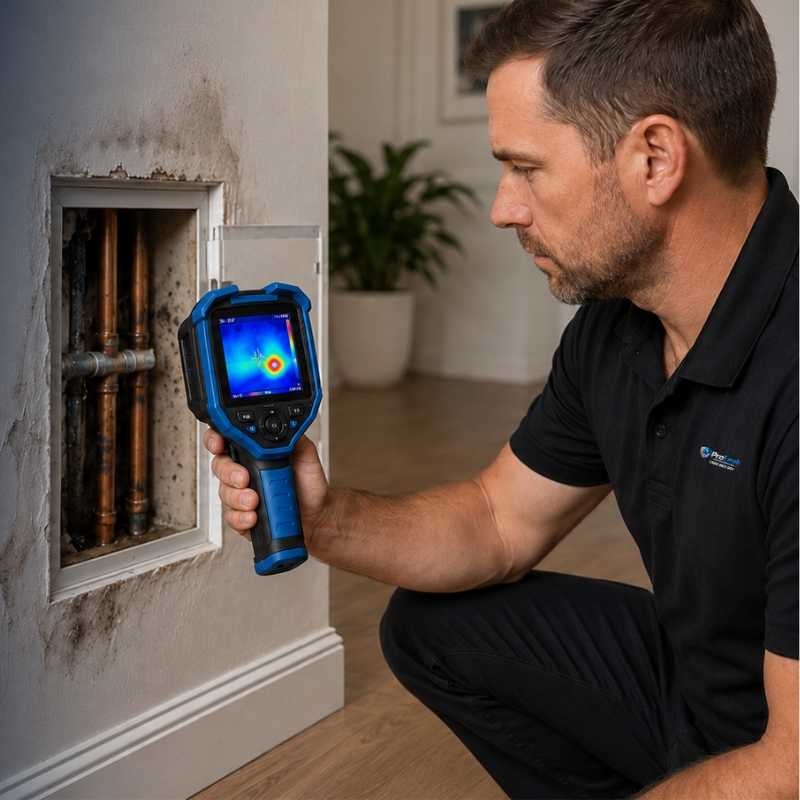
Thermal imaging devices
Wall leaks · Ceiling leaks · Slab leaks
Thermal imaging cameras identify temperature differences across surfaces. A damp section within a wall cavity, ceiling, or under-slab area can appear as a different temperature zone from surrounding dry materials, cooler in summer or warmer in winter. This non-contact, non-destructive method supports targeted investigation with a visual moisture map.
Tracer gas detection service
Most precise detection · Underground and under-slab
Acoustic listening equipment is pressed to pipes, floor slabs, and ground surfaces to detect the distinct frequency of pressurised water escaping from a leak. This sound can be detected by acoustic sensors through concrete, soil, and building materials. Different pipe types and installation depths require different sensor frequencies.
Pressure testing to isolate leaks
Confirming water loss · Isolating the line · Verifying detection
Acoustic leak detection uses electronic amplifiers pressed against pipes, slabs, and ground surfaces to detect the sound of pressurised water escaping from a breach. Water escaping under pressure produces a recognisable frequency that sensors can detect through concrete, soil, and building materials. Different pipe materials and depths need different sensor frequencies.
CCTV drain camera inspection
Drain lines · Sewer laterals · Root damage
A flexible waterproof camera is fed through sewer laterals, stormwater pipes, and drain lines to inspect pipe interiors in real time. The footage identifies cracks, root intrusion, displaced joints, collapsed sections, and foreign objects. While CCTV is not a primary pressure pipe leak detection technique, it plays a key role in diagnosing drain-related water ingress in Glenwood older clay lateral drains, where tree root intrusion is common in homes built before 1990.
What technology should be used at your Glenwood property?
This is evaluated during the free inspection
Every Glenwood property has unique conditions. Our free inspection reviews the property type, leak symptoms, and pipe age to decide which detection methods are appropriate before any work is booked. Call 1300 863 001 or book online.
Property clients we support
Leak detection for every Glenwood property owner
Water leak help for homeowners
ProLeak identifies the exact leak source in your Glenwood home when signs include an unexplained water bill, damp patches, or running water sounds, before excavation or demolition begins.
Support for rental properties
For rental homes in Glenwood, we provide fast response, written reports, and clear repair recommendations. We organise tenant access and deliver the documentation needed by landlords and agents.
Strata committees and body corporate
ProLeak assists with common area pipe leaks, shared supply line failures, and inter-tenancy leak disputes across Glenwood strata buildings. Written reports are suitable for strata committee review and insurance claims.
Pre-purchase pipe inspections
If you are preparing to buy in Glenwood, a pre-purchase leak detection inspection can detect hidden pipe leaks or concealed water damage before contracts are exchanged. Older Glenwood homes should be checked carefully.
Where hidden leaks are found around Glenwood properties
The top 6 hidden leak locations in Glenwood homes
Under-slab plumbing lines
Copper supply pipes embedded in concrete slabs from the original build can fail over time. After 40–50 years of Glenwood clay soil movement, joins and elbows may crack or come apart.
Buried water lateral
The water supply pipe connects Sydney Water’s street mains to your meter and house connection. In Glenwood, clay soil movement can cause this pipe to fracture, particularly at ageing copper or galvanised joins.
Inside wall cavities
Leaks in concealed copper pipes often occur at soldered or compression joins inside wall cavities, particularly in bathroom and kitchen wet walls. Thermal imaging helps pinpoint the affected section without opening walls unnecessarily.
Pool shell, skimmer, and return fittings
Leaks can occur where pool shell-to-coping waterproofing fails, where skimmer box seals deteriorate, or around return fittings. Clay soil movement below the pool may also stress the shell. A leaking pool in Glenwood can waste more than 100,000 litres monthly.
Hot water system inlet and outlet fittings
The cold supply and hot outlet connections on older storage hot water systems are a common source of leaks, particularly when unions have not been maintained. A small damp patch around the base of the unit is often the first sign.
Meter and service line connection
The area at and directly after the water meter is a common leak location in Glenwood properties, especially following Sydney Water meter replacements that disturb ageing pipe sections near the meter.
How ProLeak locates hidden leaks in Glenwood
Our process for detecting leaks

Free inspection available

Leak tracing
Acoustic, thermal, tracer gas, or pressure testing is chosen based on the inspection and applied without invasive disruption.

Precise leak location

Quote for repairs

Repair and check
Service region covering Glenwood
ProLeak leak detection across Glenwood 2768 and every Blacktown Council suburb
Glenwood 2768 - complete support for leak detection services
Residential, strata, commercial, and pre-purchase inspection services are available across Glenwood 2768. Free inspections, non-invasive detection, and same-week booking options available.
No unnecessary excavation · Free inspection · Same-week bookings
Coverage across all 42 Blacktown Council suburbs
Leak detection services are available throughout Blacktown Council, from Acacia Gardens, Stanhope Gardens, and The Ponds in the north to Mount Druitt, Emerton, and Rooty Hill in the south-west. We maintain the same detection technology and standards across all 42 suburbs.
All 42 suburbs in Blacktown covered
ProLeak Waterproofing - Google
Verified Business
Real feedback from Glenwood leak detection clients
Over 1,000 verified reviews and a 4.9-star average
Trustindex verifies that the original source of the review is Google. Tom was great, very easy to chat to, great price and excellent quality. Him and his team worked really hard in turning out job around. Would recommend to those needed a waterproofer.Trustindex verifies that the original source of the review is Google. excellent job on my balcony would definitely recommendTrustindex verifies that the original source of the review is Google. I got my balcony waterproofed. Excellent job highly recommend.
All areas within Blacktown Council
Water leak detection available in all Blacktown Council suburbs
2148
2147
2147
2148
2763
2148
2761
2761
2770
2761
2768
2761
2148
2148
2147
2765
2770
2761
2768
2761
2148
2763
2765
2766
2762
2768
2769
2767
Questions for homeowners in Glenwood
Water leak detection in Glenwood common questions
Can water leaks be located without digging in Glenwood?
ProLeak uses specialist leak detection methods, including acoustic listening, thermal imaging, tracer gas, and pressure testing, to find hidden pipe leaks in Glenwood before digging begins. Call 1300 863 001 to book a free Glenwood inspection.
Why is my Glenwood water bill suddenly higher?
An unexplained rise in your Sydney Water bill can indicate a hidden pipe leak on your property. First, turn all taps off and check the water meter, if the dial moves, water is flowing somewhere. If the reading changes after 15–20 minutes, call ProLeak for a free inspection. A 2mm leak under pressure can waste over 100,000 litres a month.
Do you provide free inspections for possible leaks in Glenwood?
Yes. ProLeak provides free first inspections across Glenwood 2768 and every Blacktown Council suburb. Our team checks the property, reviews the symptoms, and identifies the right detection method before any equipment is deployed. Call 1300 863 001.
Why are underground water pipes more vulnerable in Glenwood?
The seasonal expansion and contraction of clay soils in Glenwood can gradually weaken underground pipe joints. This risk increases where homes have original 1970s–80s copper pipe systems, now 40–50 years old, and are exposed to Western Sydney’s extreme temperature cycles. As a result, underground pipe failures can be more common than in coastal Sydney sandstone areas.
Can you locate swimming pool leaks in Glenwood?
Yes. In Glenwood, we’re frequently called for pool leak detection because many Western Sydney households have residential pools. Our team uses pressure testing, dye testing, and acoustic technology to find leaks at the shell, fittings, skimmer boxes, and return lines. Book a free inspection on 1300 863 001.
Do you have the proper NSW licensing for leak detection and repair work?
Do you operate in all Blacktown Council suburbs?
Yes. ProLeak offers water leak detection services across every one of the 42 Blacktown Council suburbs, including Seven Hills, Quakers Hill, Stanhope Gardens, Mount Druitt, Emerton, and Rooty Hill. Visit our Blacktown Council leak detection hub.